Sunday, 22 March 2015

Visuals

This is an anonymous piece of street art in Copenhagen that I came across online that I find interesting as it is a minimalist and symbolic stencil that speaks loudly in itself. I have now moved away from the advertisement aspect of this and just to the work of art side as I would like to go more into bold symbolism.


Best known version of this is used by the music group U2. (below)


Sources

Formative Crit Feedback

Main point from the presentation was to just keep doing more of the practical work but also bringing in some visual sources for inspiration and to get a better understanding of how to make it appeal to the target audience.

Tuesday, 17 March 2015

Progressing Ideas

As you can see, I continued with ideas that were based on the Bull Ring Shopping Centre but its not quite getting that intimate connection with the City of Colours. These are just shallow advertisements in my view, purely because of the space they're in.


Friday, 13 March 2015

Physical Space

Birmingham is a city that can be seen as on the rise in its post-industrial era. With the Big City Plan taking effect in order to improve the city centre over the next 20 years, it will be increasing the core of the city by 25%. This master plan's purpose is mostly based on improving Birmingham's economy and tourism.
Selfridges - Bullring.

The Bull Ring Shopping Centre was a big sign of this change in 2003 and its where the Filthy Luker placed his inflatable giant paintbrush for the City of Colours Festival in 2014. The Bull Ring building can be seen as impressive to young people but in the end, they could see it as "just a shopping centre".


David Harvey

Harvey argues that this mobile capitalist approach to artwork see's that the environment gets financial gain whilst re-developing the city. Following suit, the cathedral city becomes a heritage/relic town, the industrial city becomes de-industrialised, and gentrified neighbourhoods arise on the frontiers of capitalist developments. City of Colours has been argued to be responsible for participating in the regeneration of the city. By redecorating Digbeth with street art, it is connecting the community of young people with opportunities to get involved in such events. Using the workshops available and getting an insight into the art form.


Giving that the piece was designated on the side of the Bull Ring Shopping Centre, I feel that the space in which it occupied didn't reflect the tourist hot spot of the Custard Factory. I will look into designing ideas that actually reflect the City of Colours's essence.

Sources:

http://en.wikipedia.org/wiki/Big_City_Plan#/media/File:Birmingham_Selfridges_building.jpg
http://en.wikipedia.org/wiki/Big_City_Plan
http://www.endoftheline.co/endoftheline-city-colours-festival-birmingham/#!prettyPhoto[slides]/48/
http://www.endoftheline.co/wp-content/uploads/2014/09/IMG_7585.jpg
http://www.yooyahcloud.com/JIMMYC/MKremc/Birmingham_wall_with_crowd_for_web.jpg
http://www.creatingfreedom.info/wp-content/uploads/2011/06/david-harvey.jpg

Harvey, D. 2006. Spaces of Global Capitalism: Towards a Theory of Uneven Geographical Development. London and New York, Verso.


Wednesday, 11 March 2015

Lush

This is how the graffiti artist Lush sees the difference between a graffiti writer and a street artist.


Source

http://www.parisatacertainage.com/madametut/2013/10/street-art-graffiti-vandalism.html

Street Art/Graffiti

The word "graffiti" derives from the Italian word "graffare" which means to scratch on a surface. When the term graffiti is mentioned, it is often represented by its most common form known as tags. These tags are known to be a branding/message of artists or groups that are often territorial. Through most of the years that street art has been present, there has been a social stigma to the art form and the people who create it. This is possibly due to media's influences based on what they refer to as "vandalism" by people of the same social group.

Street art differs from the word "graffiti" as it is an open invitation to the general public with its pictorial representations/depictions that often reflect on social and political subjects. Street art is a visual art form in the outdoor environment as opposed to the traditional art venues. It had emerged into the world with a bang at the start of the 1980's. Both graffiti and street art are traditionally used with spray cans, a medium that doesn't wash away from weather and remains bold.


Whether these forms of expression can be seen as art or vandalism supposedly all depends on the cultural and sociological backgrounds of the audiences who view them. This usually includes key factors such as race, class, gender and age.


Source:

http://crln.acrl.org/content/75/4/208.full
https://yougov.co.uk/news/2012/04/05/graffiti-vandalism-or-acceptable-street-art/
http://en.wikipedia.org/wiki/Street_art
https://closetogreatness.files.wordpress.com/2012/02/graffiti.jpg

Tuesday, 10 March 2015

Seminar Feedback


  • More research into what the aims were by the 2014 City of Colours Festival
  • Look into and get an understanding of the cultural identity of the young adults you are aiming this towards
  • Keep in mind of it being displayed as art, an advertisement or both
  • See if you can talk to the people who were involved in the festival
  • Brief first ideas


    I've yet to create more first ideas but these are what I've begun with.

    I aim to focus mostly on the materials that will be used for these designs. The materials that will be chosen will bring a strong value to the young people of Birmingham as well as knowing the imagery that will connect the young audience to the advertisement.

    The sketch on the left is an idea of having a sheet that covers that entire section of the wall, spray painted to every inch of it with vibrant colours, with the informative advertising image in the centre. Easy to see from afar and intriguing to see up close.

    The sketch on the right is an idea of having an interactive projection on the floor, it will have people walking over it to add different colours and marks. Just something a bit more physically engaging to grab young people's attention.

    City of Colours Advertising Proposal for 2015

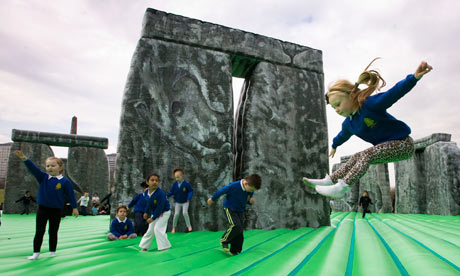
    Looking into Jeremy Deller's 'Stonehenge' in 2011, has given me more of an insight into what an inflatable artwork can achieve as far as involving the local community goes. The aim of 'Stonehenge' was to make a site with lots of unseen boundaries more accessible, and to educate people of classes that wouldn't usually visit the relic.One of the downsides of Deller's 'Stonehenge' was that as an educating piece, it was very limited. Similarly with the inflatable paintbrush by Filthy Luker, I feel that it was too vague coming from an advertising perspective.


    I want to propose a celebratory form of advertising for this year's City of Colours Festival that would be more informative to the general public. A piece that would be spread over a section of the side of the bull ring shopping centre so it can be seen from afar, yet wonderful to walk up close to it. It could even be a possible interactive object that would grasp people's attention.


    Sources

    http://static.guim.co.uk/sys-images/Arts/Arts_/Pictures/2012/4/24/1335282932825/Jeremy-Dellers-Sacrilege-008.jpg